
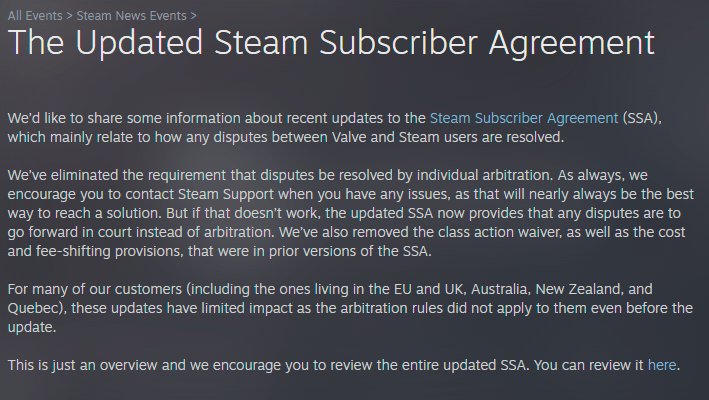
In a significant shift for its U.S. users, Valve has announced that it will no longer need individual arbitration to resolve consumer disputes. It is opting instead for traditional court proceedings. This update is reflected in the newly revised Steam Subscriber Agreement. It marks a notable change in how Valve handles conflicts with its customers. This is particularly within the United States.
What’s Changing?
In an email to users, Valve detailed that the updated agreement affects various legal rights. These changes are specifically about how disputes between users and the company are resolved. Earlier, the terms mandated that any disputes be handled through individual binding arbitration. This process is often criticized for favoring companies over consumers. The new provisions, nevertheless, clearly state: “You and Valve agree that all disputes and claims between you and Valve… shall be commenced exclusively in any state.” The new provisions also state that claims must be maintained exclusively in any state. Additionally, these claims must also be maintained in any federal court located in King County, Washington.
Who Is Affected?
This change primarily impacts users in the United States. Valve has made it clear that users in regions like the European Union, the United Kingdom, Australia, New Zealand, and Quebec will not experience significant changes. Valve assured that these regions will not be affected. The arbitration rules did not apply to them even before this update. This nuanced approach recognizes the varying legal landscapes across different jurisdictions, where some laws mandate other dispute resolution techniques.
Why the Change?
The decision to abandon individual arbitration be seen as Valve’s response. Consumers are increasingly favoring more transparent and accessible legal recourse. Arbitration can often be a complicated and opaque process, leading many consumers to feel they lack adequate representation. By shifting to court-based resolutions, Valve be looking to enhance trust and accountability among its user base.

Timeline for Implementation
Valve has already started rolling out pop-up messages on the Steam platform to inform users about the new terms. For those eager to know when these changes take effect, the new Subscriber Agreement will become the default. This change will occur on November 1, 2024. Until then, users are encouraged to review and accept the updated terms as they find them.
Conclusion
Valve signifies a noteworthy evolution in its approach to consumer rights, particularly for U.S. users. By embracing court-based resolutions, the company seems to be aligning itself more closely with consumer expectations for fairness and transparency. As this new policy rolls out, it will be interesting to see. The policy affects the relationship between Valve and its vast community of gamers. For now, users can stay informed and prepare for the upcoming changes to their legal rights on the Steam platform.

 Aizen Arcade
Leave a comment